

Suzanne Collins found the central idea for Haymitch Abernathy’s story in the writings of David Hume, an 18th-century Scottish philosopher who questioned why people accept authority and assume the future will resemble the past.
That philosophical influence became the foundation of Sunrise on the Reaping, Collins’s fifth Hunger Games novel, published on March 18, 2025. The book follows a young Haymitch during the 50th Hunger Games, 24 years before Katniss Everdeen enters the arena.
In a statement released by Scholastic, Collins identified Hume’s concept of implicit submission as a major inspiration, alongside propaganda and the political power of controlling information.
I find that philosophical starting point far more interesting than the usual reasons for writing a prequel. Collins already had a famous character, an established fictional world, and millions of readers interested in Haymitch’s past.
She could have relied on those advantages. Instead, she used his history to examine a much bigger question.
Why do people become convinced that an unjust system cannot be changed?
David Hume’s Question About Power Inspired the Novel

David Hume (1711–1776) was one of the leading thinkers of the Scottish Enlightenment.
His work explored human understanding, morality, political authority, and the assumptions people make about the world.
One of his political essays, Of the First Principles of Government, published in 1741, begins with a particularly revealing observation about rulers and ordinary people.
“The easiness with which the many are governed by the few.”
Hume was fascinated by the fact that relatively small groups of people could exercise authority over much larger populations.
His argument was that governments depend on more than physical force. They also depend on public opinion and people’s willingness to recognize established authority.
What Implicit Submission Actually Means
Implicit submission describes the tendency to accept power without constantly questioning why particular individuals or institutions should possess it.
Collins explained the connection in an interview with editor David Levithan. Her father introduced her to Hume during childhood, using everyday examples involving sunrises and billiard balls to explain philosophical ideas.
Decades later, those discussions influenced the central conflict of Haymitch’s novel.
Panem is an unusually effective fictional setting for exploring Hume’s argument. The Capitol controls the government, the military, and much of the country’s information.
Yet the districts contain the overwhelming majority of its population, and their labor sustains the society that oppresses them.
Why does that arrangement continue? Fear and violence provide part of the answer. Collins is equally interested in the beliefs that help the Capitol maintain its position.
The Novel’s Title Comes From Another Hume Idea

The connection between Hume and Sunrise on the Reaping goes beyond political authority.
The title reflects his arguments about inductive reasoning, or the way people use past observations to predict future events.
However, Hume argued that repeated experience does not provide absolute logical certainty that the same event must happen again.
His argument appears in An Enquiry Concerning Human Understanding, published in 1748.
For a closer look at Hume’s philosophical ideas, the following video introduces An Enquiry Concerning Human Understanding, the work behind one of the novel’s central themes.
As the philosophical distinction in Hume’s writing suggests, predicting that something will happen is different from proving that it must happen.
Lenore Dove Refuses to Accept the Inevitable
Collins applies that distinction to Haymitch’s understanding of the Hunger Games.
Haymitch believes the annual reaping will continue because it has always been part of his life. He has never experienced a world without it. His girlfriend, Lenore Dove, challenges that assumption.
The Games have existed for only 50 years. They were created by people, and there is no reason to treat their continued existence as an unchangeable law of nature.
Of course, expecting tomorrow’s sunrise is considerably more reasonable than accepting the permanent existence of a government-sponsored death tournament. The comparison works because it exposes a habit of thinking.
We tend to imagine the future using the conditions we already know.
For Haymitch, those conditions include the reaping. For Lenore Dove, imagining a different future is the first requirement for creating one.
Lenore Dove Gives Haymitch Something Bigger to Fight For

Lenore’s importance to the philosophical structure of the novel deserves particular attention. She’s more than Haymitch’s love interest. She challenges the assumptions shaping his entire understanding of the world.
Haymitch initially approaches the reaping as a permanent feature of District 12. He can hate it, fear it, and resent the Capitol without necessarily believing that the system could disappear.
Lenore refuses to accept that distinction between opposing something and believing it can be defeated.
Collins explained that Lenore wants Haymitch to recognize the reaping isn’t inevitable. If he assumes it can never end, he will never seriously consider helping to end it.
I think this is where the philosophical influence becomes particularly effective storytelling.
A novel about political resistance can easily turn into a series of speeches about freedom. Collins instead places an argument about the future inside a personal relationship.
Haymitch’s understanding changes because someone he loves challenges him.
That disagreement gives his story a purpose extending beyond surviving the arena. His struggle becomes connected to the possibility of ending the Games themselves.
The Capitol’s Greatest Weapon Is Its Control Over the Story
The other major influence behind Sunrise on the Reaping concerns propaganda.
Collins has explored manipulated information throughout The Hunger Games, but Haymitch’s novel places particular emphasis on how the Capitol manufactures and maintains its public image.
The Hunger Games are central to that effort.
For the Capitol, the annual competition isn’t simply a punishment imposed on rebellious districts. It’s also a televised political performance.

The government forces children to fight, then presents their behavior as evidence of humanity’s violent nature.
The resulting message serves President Snow’s interests. Without strong authoritarian control, people supposedly descend into brutality and chaos.
There is an obvious problem with that reasoning.
The Capitol creates the conditions that produce the violence, then uses that violence to justify its continued existence.
Frank Herbert explores a similarly troubling relationship between political authority and mass belief in Dune Messiah, the novel behind Dune: Part Three. Paul Atreides becomes the center of a religious empire whose followers continue celebrating him despite the enormous human cost of his rule.
It’s a remarkably convenient arrangement for the people holding the weapons.
Fifty Years of Hunger Games Create a Propaganda Problem
Collins explained that the political circumstances of the 50th Hunger Games differ from those depicted in The Ballad of Songbirds and Snakes.
By Haymitch’s time, another 40 years have passed. Many citizens no longer have direct memories of the original war between the Capitol and the districts.
The government must work harder to justify an annual punishment that continues long after the conflict that supposedly necessitated it.
Its response is an increasingly elaborate propaganda operation.
Collins specifically identifies the Capitol’s fear-based “No Peace” campaign and the manipulation of televised events as methods of influencing public opinion.
Even the presentation of District 12’s reaping becomes subject to editorial control.
Controlling Events Isn’t Enough
The Capitol isn’t satisfied with deciding what happens to people. It also wants to decide what everyone else believes happened.
A carefully edited broadcast can transform public understanding without changing the underlying events. And once people accept the manufactured version, challenging the government becomes considerably harder.
That distinction matters because propaganda works best when people don’t recognize that their understanding has been manipulated.
Collins Explores Implicit Submission on Three Levels
Collins wanted Hume’s concept of implicit submission to operate throughout the novel, rather than appear as a philosophical reference detached from the action.
She identified three connected levels of the story:
- Individual: Haymitch must confront his acceptance of the Capitol’s authority and consider whether he can resist it.
- The Hunger Games: Alliances and challenges to established arena dynamics test whether tributes must accept the competition’s usual patterns.
- National: Panem’s population must contend with the political authority concentrated in President Snow and his government.
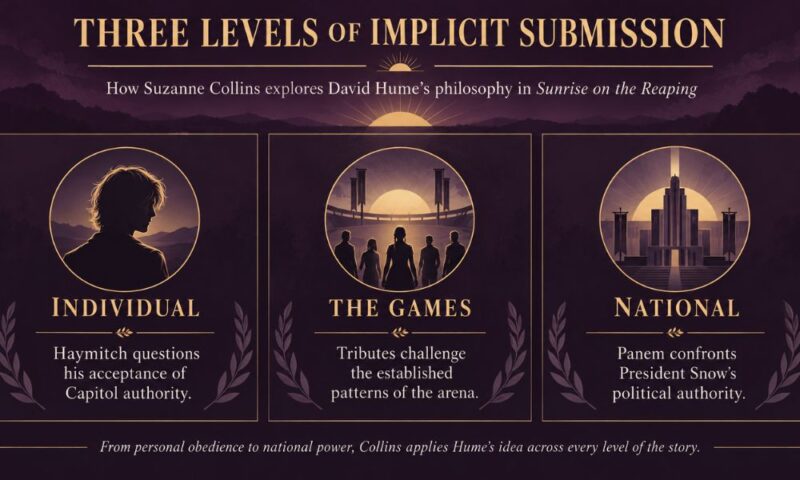
I particularly like the decision to connect these levels rather than treat them as separate subjects.
A political system can seem overwhelming when viewed nationally. Its power becomes easier to examine when the story focuses on one person deciding whether to obey.
That doesn’t mean resisting the Capitol is simply a matter of changing one’s attitude. Snow has soldiers, weapons, prisons, and an extensive machinery of punishment. The physical danger is real.
Hume’s argument identifies another dimension of that power.
The Capitol benefits when citizens believe resistance is pointless, dangerous, or contrary to their interests. Haymitch’s developing resistance challenges those beliefs.
His personal choices cannot instantly dismantle Panem’s government. However, Collins presents the willingness to imagine an alternative as a necessary beginning.
Collins Wanted Readers to Meet a Different Haymitch
One of the most interesting challenges facing Sunrise on the Reaping is that readers already know what Haymitch becomes.
In the original trilogy, he’s a cynical, frequently intoxicated mentor whose considerable intelligence is obscured by years of trauma.
Readers also know he survived the 50th Hunger Games. His prequel therefore cannot depend entirely on suspense about whether he wins.
Collins acknowledged that storytelling challenge in her March 2025 interview, explaining that knowing an outcome can shift attention toward the circumstances that produced it.
Watch: Into the Arena discusses Suzanne Collins’ interview with David Levithan and the creative decisions behind Sunrise on the Reaping.
I think that’s exactly the right approach for a character like Haymitch.
Learning the details of his victory is interesting. Understanding how an intelligent, hopeful young person becomes the deeply damaged man introduced in The Hunger Games is considerably more meaningful.
Young Haymitch Has a Different Narrative Voice
Collins also made a deliberate choice about how to tell the story.
Rather than have the older Haymitch recount his youth, she presents events through his younger perspective.
In a separate interview published by Scholastic, Collins described the younger character as possessing considerably more hope, humor, and emotional openness than the Haymitch readers already know.
His personality also reflects the cultural influence of Lenore Dove and the Covey.
The contrast gives the prequel an additional emotional purpose. Readers aren’t merely discovering the origins of Haymitch’s bitterness. They’re encountering the parts of his personality that the Capitol’s cruelty eventually suppresses.
His experiences become a story about what authoritarian power takes away from individuals, even when they survive its most obvious violence.
The Question of Truth Connects Haymitch to the Entire Series
Collins has never treated propaganda as a minor background detail in The Hunger Games.
Katniss becomes a political symbol partly because competing groups understand the power of her public image. President Snow depends on controlling appearances, and the rebellion eventually develops its own sophisticated media strategy.
Watch: The Hunger Games vs. Real History explores historical influences behind Suzanne Collins’ dystopian world and its themes of political power and resistance.
Haymitch’s story adds another perspective to that recurring conflict.
What happens when the government controls the recording, editing, and distribution of events that everyone is required to watch?
An official version of reality can become more influential than the experiences of the people who actually lived through it.
Real or Not Real?
Collins raised this concern when announcing the novel, returning to the recurring question “Real or not real?”
The phrase has an established place in the series, particularly through Peeta Mellark’s struggle to distinguish genuine memories from manipulated ones.
In Sunrise on the Reaping, questions about truth also operate on a broader political level. Information becomes a means of controlling entire communities.
I don’t think Collins is suggesting that every widely accepted account is necessarily false. Her argument is more demanding than that.
People need to recognize that information has sources, that presentations involve choices, and that powerful institutions have reasons for promoting particular interpretations.
Hume’s skepticism and Collins’s interest in political propaganda fit together remarkably well. Both encourage readers to question conclusions they have learned to accept automatically.
Haymitch’s Story Was Always Bigger Than His Victory
Sunrise on the Reaping arrives at an interesting point in the franchise’s history. The novel has already become a major publishing success, and its film adaptation is scheduled for November 20, 2026.
For the adaptation, I think preserving the philosophical conflict will be just as important as recreating the arena.
Spectacle has always been part of The Hunger Games. Collins understands that better than most writers, which is precisely why her fictional government uses it so effectively.
The real substance of Haymitch’s story lies in what happens beneath that spectacle.
David Hume’s ideas give Collins a way to connect one teenager’s personal resistance with a larger examination of political authority, obedience, and manufactured truth.
And the most important argument begins with a relatively ordinary disagreement.
Haymitch believes tomorrow will resemble yesterday. Lenore Dove insists that it doesn’t have to.
For a society built around convincing people that nothing can change, that possibility is more dangerous than it first appears.